|
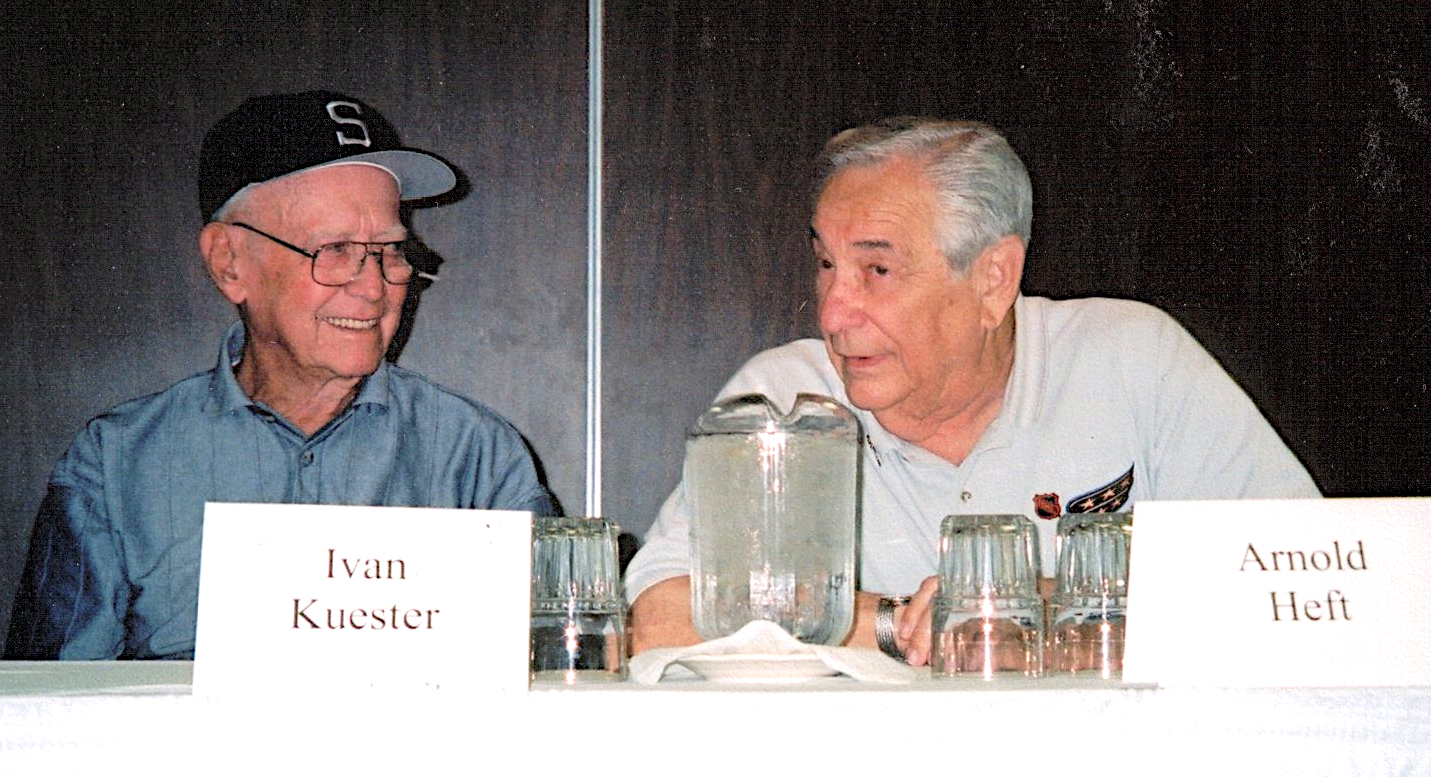
Ivan Kuester played
baseball at Reitz High School in Evansville, Indiana and graduated
in 1938. He attended a tryout camp
held at Bosse Field, home of the Evansville Bees. Manager Bob
Coleman signed the 19-year-old outfielder to a professional contract
with the Boston Bees organization and sent him to their Class D club
at Bradford, Pennsylvania in the Pennsylvania-Ontario-New York
(PONY) League. He signed for about $125 a month. In 75 games, he
batted .291 with 20 doubles and 38 runs batted in.
In 1941, the Boston
organization sent Kuester to the Owensboro Oilers in the Kitty
League, beginning a six-year stint as a player and manager in the
Class D circuit. He batted .306 with 28 doubles, 10 triples, 4 home
runs, 76 RBI, and 19 stolen bases. He returned the following season
and hit .311 before the league folded in June 1942. He finished the
year at Canton (Class C Middle Atlantic League) and with his
hometown team, the Evansville Bees (Class B Three-I League).
After serving his country
during World War II, Kuester resumed his playing career in
Owensboro. He batted .303 in 98 games before the Boston Braves
ticketed him for their Class A Hartford club in the Eastern League.
The Oilers held a special Southern Indiana Night to honor Kuester
and fellow Indiana natives George Buickel and Dick Fischer before he
left for Hartford.
Kuester played 40 games at
Hartford, Bluefield, and Fort Lauderdale, hitting .242 overall with
all three clubs.
Kuester decided to try his
hand at managing. He applied for the vacancy with the Hopkinsville
Hoppers before the 1948 season, a position eventually filled by Vito
Tamulis. The former major league pitcher led the Hoppers to the
Kitty League pennant and the second-best winning percentage in
league history. On July 20, the Fulton Railroaders hired Kuester as
their third manager of the season.
In 1951, the Washington
Senators intended to promote Kuester to the Class B Selma
Cloverleafs in the Southeastern League. But the circuit folded
before the season began and he was sent to the Chattanooga Lookouts
instead. He served as third base coach for manager Jack Onslow, who
had managed the Chicago White Sox the previous season. Kuester
enjoyed the challenge and the higher competition level in the
Double-A Southern Association. “That was pretty fast company,”
he recalled.
“I
was an aggressive coach at times,” he recalled. “Oh, I got a few
thrown out. The big guy [who] really hurt me more than anyone when I
was coaching at third base was Jimmy Piersall. He played center
field for Birmingham and he played a short outfield. If you hit a
line drive to him on the ground anywhere close, you couldn’t score
on him.
“So
one night we’re down there playing in Birmingham and we had Pete
Runnels on second base and two out. The guy got a base hit through
the middle and it was a routine ground ball. I sent him in and Pete
got thrown out at the plate. Jack Onslow, the manager, said, ‘All
right, let me take third for a while.’ So I went down to first
base; it was the only time I coached first base all year. We had a
runner on second base named Daniel Porter and nobody out. A fly ball
was hit to Piersall and it was fairly deep. Jack had Porter come to
third base and Piersall threw him out. After the inning, he said,
‘Go on back to third base. Just don’t try to score him if
Piersall gets the ball.’”
The following season,
Kuester received his Class B promotion and managed the Charlotte
Hornets in the Tri-State League. “I was supposed to win the
pennant,” he recalled. “I didn’t and finished a
game-and-a-half out and I got fired.” The Hornets finished in
second place behind the Gastonia Rockets with a record of 87-51.
Despite losing the pennant, the club did win the postseason
Shaughnessy playoffs.
Kuester
returned to Class D ball in 1953 as player-manager of the Bluefield
Blue-Grays in the Appalachian League. The Senators farm club’s
last-place finish marked the end of his managerial career.
Kuester
remained with the Washington Senators as a full-time scout. “The
old Washington Senators were a family organization and a good
organization,” he recalled. “They didn’t have a lot of money,
but they always treated you good.”
Over
the next fifty years, he scouted for other major league teams such
as the Kansas City Athletics, St. Louis Cardinals, and Atlanta
Braves. He also coached high school, collegiate, and amateur
baseball teams in the Evansville area.
|